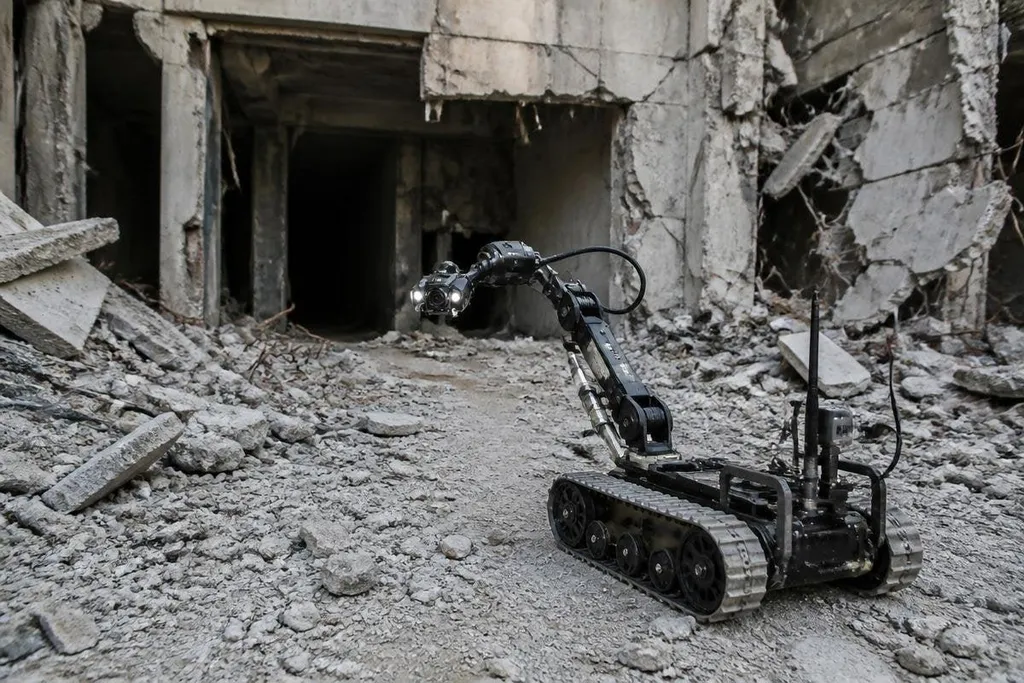
A robot can enter a damaged building, move below the sea, or work near toxic gas without putting a person inside first. Its value comes from the parts that replace human senses and movement: cameras, force sensors, wheels, tracks, legs, and remote control.
For industry readers, the main question is practical: which machines can work in places that are too hot, cold, deep, radioactive, unstable, or dangerous for people?
- Danger moves away from the operator: remote control keeps people outside the work area.
- The body follows the job: wheels suit floors, tracks suit loose ground, and legs suit steps or broken surfaces.
- The hard part is trust: a robot must send back useful video and sensor data before people can act on its findings.
The machine takes the risk
People bring eyes, hands, balance, hearing, and judgment to a task. A robot has to replace those functions with hardware and software that can keep working in poor conditions.
Cameras can show a remote operator what is ahead. Thermal cameras can reveal heat that a normal camera misses. Force sensors can tell the control system when an arm has touched an object, which matters when the operator cannot see the contact point clearly.
Remote operation changes the risk calculation. A person can stay outside a collapsed structure while a tracked robot checks a passage. An underwater robot can inspect a ship or pipeline while its operator remains at the surface. The operator still makes decisions, but the robot carries the sensors and tools into the work area.
That arrangement has a limit. A video feed can show a blocked doorway, yet it may not show whether the floor will support the robot. Software can plan a route, but dust, water, smoke, or poor lighting can reduce the quality of the sensor data.
Mobility follows the ground
The ground decides what a robot can do.
Wheels use less energy on a firm floor and can move quickly across a plant or road. Tracks spread the robot's weight over a larger area, which helps on loose soil, rubble, or wet ground. Legs can step over gaps and place each foot with care, but they need more control and can lose balance.
Underwater systems face a different set of problems. Water adds drag, blocks radio signals, and changes how tools move. A tether can carry power and data back to the surface, but the cable can snag on structures. An untethered robot has more freedom, yet its battery and communication range limit the work time.
In space or sealed industrial areas, the machine may need to work without a person nearby for long periods. That calls for fault checks, safe stop behavior, and a way to recover when a motor stalls or a sensor gives a bad reading. The task cannot depend on a person fixing every error at once.
The link between a machine’s design and its job matters here. Reports on automation projects give you examples to compare when a robot must act without a person nearby.
Autonomy has a narrow job
Autonomy means the robot can handle part of a task without a person directing every movement. It may hold a set distance from a wall, avoid an obstacle, or return to a known point when its connection drops.
That does not mean the robot understands an unknown place as a person does. A system trained for smooth floors may struggle on rubble. A gripper that works on fixed objects may fail when an item is wet, loose, or partly hidden.
The best setup often divides the work. The robot handles balance, motor control, and obstacle checks. A person chooses the route, confirms a risky action, or takes control when the scene changes.
A practical buying check
Before choosing a robot for a place people cannot enter, check these points:
- Ground type: list floors, stairs, loose soil, water, rubble, or narrow gaps.
- Hazard level: define heat, chemicals, radiation, pressure, smoke, and falling objects.
- Control link: test the range, delay, cable path, and behavior after signal loss.
- Sensor view: confirm that the operator can see depth, heat, contact, and obstacles.
- Recovery plan: decide how the robot will be moved or repaired after a stuck motor, low battery, or damaged cable.
I’d choose the robot with the clearest failure behavior over the one with the longest feature list.
Robots will keep reaching places humans cannot, but each job still sets a hard boundary: the machine needs enough power, sensing, control, and recovery support to return with useful data.